
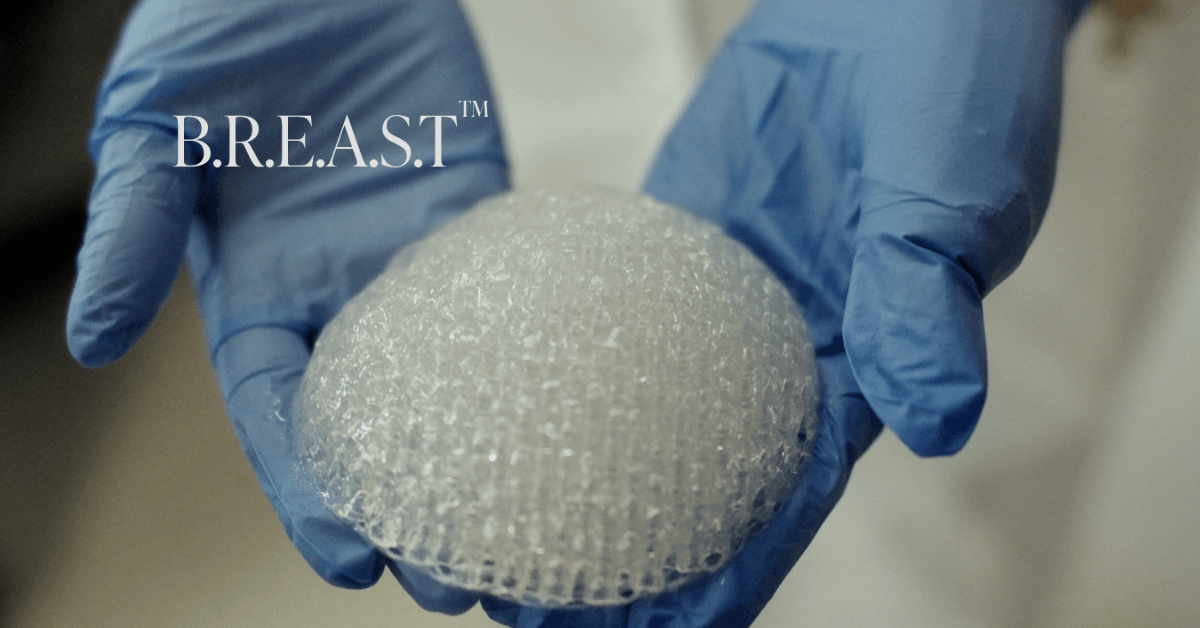
Conexeu Sciences Inc., a biotechnology company advancing tissue regeneration, announced the development of BIO-REGENERATIVE ERGONOMICALLY ARCHITECTED SMART TISSUE™ (B.R.E.A.S.T.™), a novel 3D-bioprinted breast matrix designed to advance reconstruction beyond implant-based replacement and toward tissue regeneration.
B.R.E.A.S.T.™was developed using Conexeu’s proprietary CXU™ platform, an extracellular matrix (ECM)-based biofabrication technology. B.R.E.A.S.T.™ introduces a new implantable device in soft tissue restoration: a resorbable and bioregenerative matrix engineered to guide the patient’s own cells towards the formation of new tissue.
Miles D. Harrison, President and CEO of Conexeu, added: “For more than 50 years, breast reconstruction has been defined by substitution, replacing what was lost with a foreign body. We are fundamentally shifting the paradigm from substitution to restoration. Conexeu was founded on the belief that the promise of regenerative medicine is real, but only if it is supported early, advanced with rigor, and translated into clinical practice. The field has accepted repair and implants as the ceiling. We refuse to. If we settle for those limitations, true bio-regeneration will remain out of reach.”
Each year in the U.S., more than 100,000 women undergo mastectomies and roughly two-thirds of those women who undergo a mastectomy do not pursue breast reconstruction. Today’s breast reconstruction options of implants, tissue flaps, and fat grafting, are designed to restore the shape and volume of the breast, not to regenerate the breast’s own living tissue. Conexeu is changing that by developing a structure the body recognizes as its own, serving as a temporary guide for the body to rebuild itself, not a permanent implant.
“We did not set out to design abetter implant. We set out to eliminate the need for one,” said Dr. Claudia Chavez-Munoz, Chief Scientific Officer and co-founder of Conexeu. “By combining controlled 3D architecture with a biomimetic extracellular matrix, we are developing a structure that the body can recognize, integrate, and ultimately replace with its own living tissue.”
Conexeu’s B.R.E.A.S.T.™is being developed as an acellular, resorbable, regenerative scaffold, rather than a permanent implanted prosthesis. The platform combines structural architecture with naturally derived extracellular matrix proteins that allow for a controlled cell migration, vasculogenesis, tissue integration,and remodeling, all supported by the patient’s body. Unlike synthetic polymers-based scaffold approaches, the Conexeu platform is designed to provide both mechanical support and biological support intended to facilitate direct tissue remodeling rather than merely occupying space.
The Conexeu platform is grounded in more than ten years of preclinical evidence across eleven peer-reviewed publications and proprietary preclinical data. Dr. Z. Paul Lorenc, Plastic Surgeon and Director at Conexeu, said: “Nothing can be more beneficial to a patient than knowing their own body could have the ability to repair and regenerate itself. Whether for reconstructive purposes or for aesthetic autologous breast and body enhancement, Conexeu’s 3-D bioprintable matrix offers the potential towards true regenerative medicine.”
The CXU™ platform contemplates personalized, patient-specific designs and fabrication. Medical imaging such as CT scans could be used to create customized 3D structures tailored to a patient’s anatomy and reconstructive requirements. The design intent for the B.R.E.A.S.T.™ matrix is to transition from mechanical support to biological integration, with the host tissue progressively replacing the scaffold volume on a timeline aligned with tissue formation and remodeling.